Child Custody Bilder: A Practical, Editable Organizer for Co-Parenting Clarity
When navigating the emotional and logistical complexity of shared parenting after separation or divorce, clarity isn’t just helpful—it’s essential. A Child Custody Bilder—a term increasingly used to describe a structured, visual, and highly functional custody documentation system—goes beyond basic note-taking. It transforms fragmented records into a unified, actionable resource. At its core, the Child Custody Bilder is not merely a printable PDF; it’s a thoughtfully sequenced, professionally designed, and fully editable co-parenting toolkit built for real-world use—not theoretical idealism.
Why Structure Matters More Than Ever in Modern Co-Parenting
Today’s families operate across multiple platforms, time zones, and communication channels. Texts get lost. Emails pile up. Verbal agreements fade. Without consistent, neutral documentation, even well-intentioned parents risk misalignment—on visitation timing, medical consent, school updates, or financial contributions. The consequences extend beyond inconvenience: ambiguous records can weaken credibility in court, delay resolution of disputes, and unintentionally heighten conflict. A robust Child Custody Bilder mitigates these risks by establishing a shared factual foundation—one that’s both legally sound and emotionally grounded.
Inside the Design: How Function Drives Form
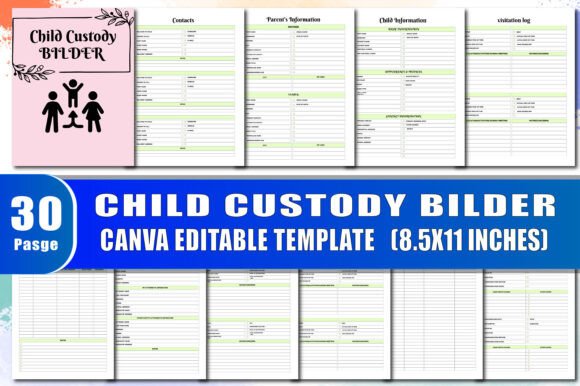
This particular Child Custody Bilder is delivered as a 30-page, 8.5 x 11-inch interior, optimized for Amazon KDP and high-fidelity printing (300 DPI, no bleed). But its value lies not in page count—it’s in the intentional architecture behind each section. Every page serves a distinct operational purpose, avoiding redundancy while supporting continuity. For example:
- The Belongs to Page and This Book Belongs To pages aren’t decorative—they anchor ownership and responsibility before any entries begin, reinforcing accountability from the first interaction.
- The Child Information and Parents’ Information spreads consolidate vital identifiers (birthdates, SSN placeholders, insurance details) in one secure location—no more flipping between files or apps during urgent calls with schools or clinics.
- Visitation Log and Supervised Visitation Log are designed with dual-column timestamps, drop-down status options (e.g., “On Time,” “Late 12 min,” “Cancelled – Reason”), and space for brief observations—capturing patterns over time without demanding narrative detail.
- The Court Case Information spread includes fields for case number, jurisdiction, judge name, and filing date—structured to align with clerk office requirements and attorney intake forms.
Crucially, the layout anticipates workflow, not just storage. The Visitation Planner offers a clean monthly grid—ideal for previewing upcoming schedules—while the adjacent Schedule Change page provides dedicated space to document mutual adjustments *with dated signatures*, creating an auditable trail of cooperation.
Editable Flexibility Without Compromising Professionalism
Unlike static templates locked in PDF-only formats, this Child Custody Bilder comes with a direct, editable Canva link. That means users can adjust colors, fonts, spacing, or even reposition elements—without design expertise. A parent using dark mode may lighten background tones; a bilingual household might add Spanish headers beside English ones; a therapist working with high-conflict clients could insert custom safety prompts on the Incident Log page. Yet none of these edits sacrifice print integrity: all layers remain properly aligned, bleed-free, and resolution-optimized at 300 DPI.
The inclusion of high-resolution JPG and PNG exports further extends utility—enabling integration into digital dashboards, secure client portals, or collaborative cloud folders. Meanwhile, the final print-ready PDF preserves typographic hierarchy, consistent margins, and accessible contrast ratios—meeting both KDP submission standards and accessibility best practices.
Real-World Applications Across User Profiles
While often associated with legal self-representation, the Child Custody Bilder serves diverse stakeholders:
- Family Law Attorneys use it as a client intake accelerator—assigning the binder pre-consultation ensures they receive organized, standardized data rather than scattered screenshots and voice memos.
- Guardians ad Litem and Court Appointed Special Advocates (CASA) rely on the Court Notes and Lawyer Notes sections to cross-reference testimony, track compliance, and prepare concise reports.
- School Counselors and Pediatricians benefit from the Child Information and Agreement References pages when verifying consent protocols or understanding custody parameters affecting care decisions.
- Mediators integrate the Communication Log and Concerns Raised spreads into sessions—using documented exchanges to depersonalize conflict and refocus dialogue on child-centered outcomes.
- Self-Represented Litigants gain confidence knowing their evidence log, payment tracker, and document repository follow court-preferred conventions—even without legal training.
Tracking Beyond Time: Financials, Communication, and Well-Being
Many custody tools stop at scheduling—but consistency requires holistic tracking. This Child Custody Bilder integrates three critical dimensions often siloed elsewhere:
- Financial Accountability: The Child Support Payment Tracker logs dates, amounts, methods (cash, Zelle, check), and receipt numbers—linking directly to state enforcement guidelines. Paired with the Spending LOG, it creates transparency around extracurricular fees, medical co-pays, or educational expenses—reducing “who paid for what” disputes.
- Communication Integrity: The Communication Log goes beyond timestamps. It captures channel (text/email/phone), topic (e.g., “dentist appointment,” “homework issue”), and outcome (“agreed,” “pending response”). Over weeks, it reveals responsiveness patterns—valuable both for mediation and, if needed, evidentiary submissions.
- Developmental Context: Sections like Weekly Notes, Monthly Notes, and Concerns Raised encourage observational reflection—not just event logging. Noting a child’s increased anxiety before transitions, new interests emerging during visits, or academic shifts provides longitudinal insight no calendar alone can offer.
Design Choices That Support Emotional Resilience
Practicality doesn’t require austerity. Subtle design considerations reinforce psychological safety: soft, gender-neutral palettes (avoiding stereotyped blues/pinks), ample white space to reduce cognitive load, and intuitive iconography (e.g., a small calendar next to “Court Dates,” a speech bubble beside “Communication Log”). The Thank You page—placed near the end—is intentionally non-transactional. It invites acknowledgment of effort, not just outcomes—a quiet reminder that co-parenting is sustained by intentionality, not perfection.
Implementation That Fits Real Life
No tool succeeds without adoption. This Child Custody Bilder supports sustainable use through low-barrier entry points:
- Modular Use: Parents needn’t complete all 30 pages at once. Start with Child Information, Contacts, and Visitation Log—then layer in financial or clinical tracking as routines stabilize.
- Dual-Format Syncing: Maintain the printed binder for in-person handoffs or court appearances, while using the editable Canva version for quick updates between visits—then export updated PDFs weekly.
- Document Integration: The DOCUMENTS section includes labeled tabs for scanned custody orders, medical releases, school enrollment forms, and signed agreements—turning the binder into a living archive, not a static artifact.
Looking Ahead: Documentation as Partnership Infrastructure
As family structures evolve—and as courts increasingly emphasize cooperative parenting models—the role of documentation shifts from reactive evidence to proactive infrastructure. A well-maintained Child Custody Bilder doesn’t replace dialogue; it deepens it. When both parents reference the same Visitation Planner or review the shared Spending LOG, assumptions dissolve. When a teacher sees consistent notes across households in the Weekly Notes section, support becomes more cohesive. And when a judge reviews a cleanly organized Court Dates and Incident Log timeline, credibility is established before a word is spoken.
Ultimately, the strength of a Child Custody Bilder lies not in its completeness, but in its consistency—in how reliably it reflects reality, honors process, and centers the child. Whether used by a solo parent preparing for mediation, a social worker coordinating services, or a grandparent stepping into caregiving, it offers something rare in high-stakes family dynamics: structure with sensitivity, precision with compassion, and order without rigidity.