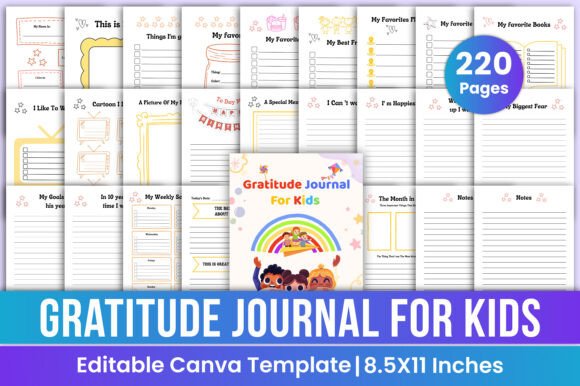
Gratitude Journal for Kids Colorful
Gratitude Journal for Kids Colorful isn’t just another printable—it’s a purpose-built workflow tool for adults who guide children’s emotional development: educators designing SEL-aligned classroom routines, therapists integrating expressive tools into sessions, homeschooling parents building consistent reflection habits, or content creators developing downloadable resources for young learners. Its value lies not in isolation, but in how seamlessly it plugs into existing systems—lesson planning, therapeutic frameworks, family rituals, or digital product pipelines.
The journal functions as both a scaffold and a mirror. As a scaffold, it structures unstructured emotional awareness—breaking down abstract concepts like “gratitude” or “fear” into concrete, age-appropriate prompts. As a mirror, it gives adults real-time insight into a child’s inner world: shifts in self-perception, emerging social preferences, evolving sources of joy or stress. That dual function makes it especially useful before, during, and after key developmental touchpoints—like starting a new school year, navigating a family transition, launching a creative project, or supporting a child through anxiety or low motivation.
How It Fits Into Real Workflows
In classroom settings, teachers use the Belongs to and This is Me pages during the first two weeks of term—not as busywork, but as baseline data collection. These pages surface patterns: Which students name relationships as core sources of happiness? Who lists competence (“Things I’m good at”) with specificity versus vagueness? That informs differentiated support long before formal assessments begin. The editable Canva format means educators can adapt language—for example, swapping “My Biggest Fear” for “Something I’m Learning to Feel Braver About”—without redesigning from scratch.
For therapists and counselors, the journal serves as a low-pressure entry point into deeper work. Rather than asking “How are you feeling today?”—a question many kids deflect—the structured prompts provide scaffolding: “A Special Memory” invites narrative without demand; “I’m Happiest When…” reveals environmental and relational triggers for positive affect. Completed pages become tangible artifacts to review across sessions, supporting continuity and measurable progress tracking. Because each template is editable on Canva, clinicians can embed visual cues (e.g., emotion icons), simplify vocabulary for younger clients, or add therapist-specific reflection questions directly into the layout.
For creators and small business owners selling digital products, Gratitude Journal for Kids Colorful is a production-ready asset. Its Canva-editable structure eliminates the need for custom design software or developer handoff. You prepare one master file, then duplicate and modify for niche variations—e.g., a version themed for neurodivergent learners (with sensory-friendly color palettes and reduced text density), or one aligned with school curricula (adding Common Core–referenced reflection prompts). This accelerates time-to-market and supports A/B testing: publish two variants, track download-to-completion rates, and iterate based on actual usage—not assumptions.
Integration With Other Tools and Systems
Gratitude Journal for Kids Colorful doesn’t replace other tools—it complements them. Pair it with:
- Classroom behavior charts: Use weekly gratitude entries (“3 Things I’m Grateful For”) as reflective follow-ups to positive reinforcement, deepening the connection between action and internal reward.
- Digital habit trackers (like Habitica or Google Sheets): Export completed journal pages monthly and log themes—e.g., frequency of family-related gratitude mentions—to spot trends alongside academic or behavioral data.
- SEL curriculum frameworks (e.g., Second Step or RULER): Map journal prompts to specific competencies—“My Favorite Place” aligns with self-awareness; “What Made Today Good?” supports responsible decision-making.
- Family meeting agendas: Assign one journal section per week as a shared reflection activity—e.g., “Draw Your Favorite Activity Together,” then discuss what made it meaningful.
Its compatibility hinges on flexibility—not just visual (colors, fonts, layout) but functional. Because text, spacing, and section order are fully editable in Canva, you’re not locked into a fixed interpretation of “gratitude.” You can emphasize growth mindset (“One Thing I Tried That Was Hard”), cultural relevance (“A Tradition My Family Celebrates”), or even literacy development (“Write One Sentence About Why I Like This Book”). That adaptability ensures alignment with organizational values, pedagogical priorities, or client goals—without requiring technical customization.
Practical Implementation Tips
Start small, not perfect. Don’t launch with all 20+ pages. Begin with three high-leverage sections: This is Me (baseline identity mapping), A Special Memory (narrative grounding), and 3 Things I’m Grateful For (daily anchoring). Introduce one per week. Consistency matters more than volume—five minutes, three times a week, builds neural pathways more effectively than one dense session monthly.
Use editing intentionally—not decoratively. Changing colors or fonts isn’t just about aesthetics. Swap muted tones for high-contrast palettes for children with visual processing differences. Replace serif fonts with dyslexia-friendly sans-serifs. Add checkboxes or speech bubbles for nonverbal or pre-literate users. Every edit should serve a functional outcome: clarity, accessibility, or engagement.
Build in feedback loops. Reserve space—either digitally (a comment box in Canva) or physically (a sticky note margin)—for adult observations. Note patterns: Does “My Best Friends” shift after a conflict? Does “I’m Happiest When…” consistently reference unstructured outdoor time? That observational layer transforms the journal from a passive record into an active diagnostic tool.
Plan for longevity—not just completion. Store completed journals digitally (scan or export as PDF) and tag by date and theme. After six months, revisit early entries alongside recent ones. Look for evolution in language (“I like ice cream” → “I like sharing ice cream with my sister”), expanding self-concept (“Things I’m good at” now includes empathy or patience), or increased emotional granularity (“My Biggest Fear” becomes more specific and manageable). This longitudinal view supports both child development tracking and your own professional reflection.
Why Editable-on-Canva Matters for Workflow Efficiency
Editable-on-Canva isn’t a marketing buzzword—it’s a workflow multiplier. It removes friction between intention and execution. Need to translate one page into Spanish for bilingual families? Duplicate the template, paste translated text, adjust line breaks, and export—no font licensing issues, no layout collapse. Preparing materials for a workshop? Embed your organization’s logo, adjust header colors to match brand guidelines, and generate branded PDFs in under five minutes. Supporting a child with ADHD? Reduce cognitive load by deleting lower-priority sections, increasing font size, and adding visual anchors—all within the same interface used for slide decks or social graphics.
That interoperability extends beyond design. Canva files integrate natively with Google Drive, Dropbox, and email—making distribution, collaboration, and version control frictionless. No need to manage layered PSDs or wrestle with print-ready PDF settings. What you see is what you send—and what the child engages with.
Gratitude Journal for Kids Colorful works because it meets children where they are emotionally—and meets adults where they are practically. It doesn’t ask you to overhaul your systems. It asks you to slot in one adaptable, evidence-informed tool that pays dividends across emotional literacy, relationship-building, and long-term well-being—without demanding extra hours, specialized training, or technical overhead. The most effective tools aren’t the flashiest. They’re the ones you reach for, again and again, because they simply make the next right step easier to take.