2025–2026 Anger Management: A Practical, Year-Long Toolkit for Real Life
You’ve had that moment—your chest tightens during a tense team call, your jaw clenches while scrolling through yet another inflammatory news headline, or you snap at your partner after a 14-hour workday. Anger isn’t the problem. How we respond to it is. The 2025–2026 Anger Management resource isn’t another abstract self-help guide—it’s a grounded, editable, year-spanning toolkit designed for people who need clarity *now*, not someday.
It’s built around two full calendar years—January 2025 through December 2026—with monthly planners that don’t just track deadlines, but invite reflection. Each month includes space to log triggers (“What lit my fuse?”), notice physical warning signs (clenched fists, shallow breathing, heat in your face), and test coping skills that actually fit your rhythm—not someone else’s idealized routine.
Where and When This Actually Fits Into Your Week
This isn’t meant for a quiet Sunday morning with tea and journaling—though it works there too. It’s built for the in-between moments: the 90 seconds before your next Zoom meeting when you realize your heart’s racing; the 7 a.m. coffee pause before school drop-off; the 10 p.m. scroll-stop when you catch yourself ruminating instead of resting.
Freelancers and solopreneurs use the “Weekly Debrief” pages to untangle frustration from client scope creep—not by venting, but by asking: What part felt unfair? What boundary could I name next time? Teachers print the “Anger Warning Signs” page and tape it inside their lesson-planner cover—so when a chaotic hallway moment spikes their stress, they pause, check their thermometer scale (0–10), and choose one grounding move before reacting.
Remote workers open the Canva-editable file mid-afternoon, duplicate the “Reframe Your Thinking” page, and swap in their own recent trigger: “My manager didn’t reply to my update → I’m invisible” becomes “My manager is juggling three urgent fires → My update may land tomorrow.” That small edit changes everything—not because it’s positive thinking, but because it restores agency.
Why Editable Canva Access Changes How You Use It
You don’t need design skills. You need flexibility. The 2025–2026 Anger Management files include an editable Canva link—no subscription required. Want to add your company logo to the “When I Am Angry” worksheet for team wellness workshops? Done. Need larger font for aging parents joining your family mental health initiative? Two clicks. Prefer landscape layout for tablet use during therapy sessions? Easy.
That adaptability matters because anger shows up differently across contexts. A nurse uses the “Anger Tracking” grid to spot patterns between shift changes and irritability. A parent adapts the “What Works For Me” page into a visual chart for their teen—using icons instead of text. A content creator repurposes the “Identifying Triggers” spread as a behind-the-scenes Instagram carousel, normalizing emotional awareness without oversharing.
Real Outcomes—Not Just Pretty Pages
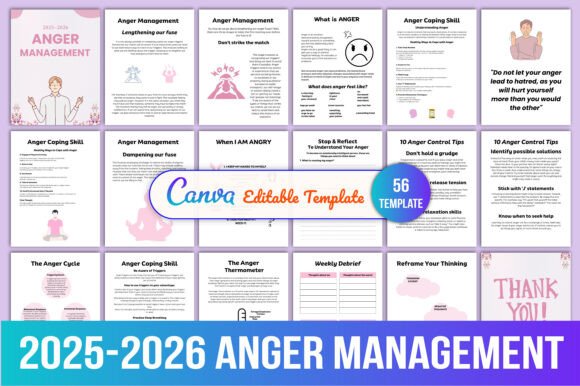
The value isn’t in owning 56 high-resolution templates (though yes—they’re all 8.5×11", 300 DPI, no bleed, print-ready PDF/JPEG/PNG). It’s in what happens *after* you open them:
- Your weekly team check-in shifts—instead of skipping straight to tasks, you spend 3 minutes on the “Stop Reflect To Understand Your Anger” prompt. One colleague names feeling dismissed in last week’s brainstorm. Another admits avoiding feedback. Suddenly, the real bottleneck isn’t workload—it’s unspoken resentment.
- Your morning routine gains texture. You glance at the “Anger Thermometer” on your fridge—color-coded from calm (blue) to overwhelmed (red)—and notice you’ve hovered in orange for three days. So you adjust: swap one podcast for silence, move a non-urgent call, text a friend instead of scrolling.
- Your notes become actionable. The two “My Notes” pages aren’t blank journals—they’re structured with gentle prompts: “One thing I noticed about my tone today…” or “A situation where I paused before speaking…” That small nudge turns vague guilt into observable behavior—and observable behavior is changeable.
What to Consider Before You Begin
This isn’t a fix-all. It won’t erase chronic stress, systemic inequities, or untreated anxiety—but it *does* give you concrete ways to respond when those forces collide in your body and relationships. If you’re in active crisis or experiencing violence (toward self or others), this complements—but doesn’t replace—professional support.
Also: don’t feel pressured to fill every page. Start with just one—“The Anger Cycle” diagram, for example. Trace a recent flare-up backward: What happened right before? What thoughts ran through your mind? What did your body do? That single pass builds neural pathways for recognition—the first, most vital step in regulation.
And if you’re sharing this with others—clients, students, colleagues—remember: permission matters. Handing someone a “What Light My Fuse” worksheet isn’t about diagnosing their emotions. It’s offering a neutral, nonjudgmental map they can use—or ignore—on their own terms.
More Than Calendars—It’s Continuity
Most planners end on December 31st and leave you starting over. The 2025–2026 Anger Management bridges both years intentionally. You carry forward insights: the coping skill that worked in March 2025, the trigger pattern you spotted in August, the reframe that softened a recurring argument. That continuity mirrors how emotional growth actually happens—not in sprints, but in layered, overlapping seasons.
Whether you’re designing a workplace wellness program, supporting a loved one through burnout, building a mindful content series, or simply trying to stop yelling at your dog when the Wi-Fi drops—you’re not looking for perfection. You’re looking for tools that fit your hands, your schedule, and your honesty. These pages meet you there—no fluff, no jargon, just 56 thoughtful, adaptable, real-world anchors for navigating anger with more grace, clarity, and choice.
Thank you for visiting my product. If you like this product then, don’t forget to visit…