Editable Party Event Planner: A Strategic Tool for Purposeful Planning and Professional Execution
An Editable Party Event Planner is more than a printable checklist—it’s a structured decision-making framework designed to convert intention into outcome. Whether you’re launching a small business pop-up, hosting a milestone celebration, coordinating a corporate team event, or building a scalable digital product line for KDP, this planner serves as both an operational backbone and a creative canvas. Its value isn’t in its completeness alone, but in how thoughtfully it aligns with your goals, constraints, and standards.
Why Structure Matters More Than Spontaneity
Unstructured planning often leads to reactive decisions: last-minute vendor calls, mismatched branding, budget overruns, or misaligned guest expectations. The Editable Party Event Planner counters that by embedding discipline into flexibility. Because it’s built with editable layers—fonts, colors, layouts, images, and backgrounds—you retain full creative control without sacrificing organizational rigor. That duality is rare: most tools force a trade-off between customization and structure. This one bridges them.
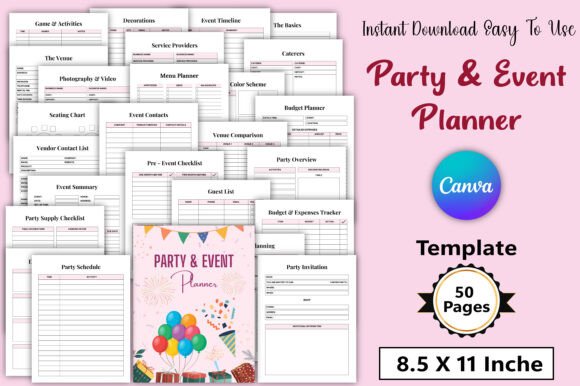
For example, a freelance event coordinator using the planner for client proposals doesn’t just list “venue comparison” — they use the dedicated two-page spread to visually contrast capacity, accessibility, cost per head, and photo permissions. That same section becomes a negotiation tool—not just internal tracking. Similarly, a small-batch bakery launching a themed launch party uses the Theme Color Scheme and Decorations pages not only to plan decor but to pre-visualize Instagram story templates, packaging labels, and staff uniforms—extending the planner’s utility beyond logistics into brand coherence.
Strategic Use Cases Across Roles
The real power of the Editable Party Event Planner emerges when matched to specific objectives—not generic tasks.
- For KDP publishers: The JPG, PNG, and PDF formats are print-ready for Amazon’s interior requirements—and the included Canva link means you can adjust margins, bleed, or typography before final export. No reformatting headaches. You’re not just selling a planner; you’re delivering a production-ready asset with built-in scalability.
- For educators and trainers: The Daily Planner, Weekly Planner, and To Do List sections function as teaching scaffolds—helping students break large projects (e.g., school galas or capstone events) into sequenced, accountable actions. The Delegate List and Vendor Contact List become live case studies in stakeholder management.
- For solopreneurs and creators: When launching a digital course on event design, the Event Timeline and Pre-Event Checklist serve double duty: as your own launch roadmap *and* as a downloadable bonus for students—reinforcing credibility through demonstrated process.
- For home users seeking consistency: The Belongs To page and Notes (5 pages) aren’t decorative—they anchor ownership and reflection. Reusing the same planner across multiple events builds personal methodology: What worked in June’s backyard wedding informs October’s holiday market booth. That continuity compounds learning.
What to Consider Before You Customize
Editing without intention dilutes impact. Swapping fonts or swapping color palettes feels productive—but unless those changes support a goal (e.g., improving readability for aging guests, reinforcing brand recognition at a vendor fair, or signaling formality vs. casual tone), they add noise, not value.
Ask yourself before opening Canva:
- Who is the primary user? Is it you alone? A team? Clients? A printer? Each shifts priorities—e.g., a printer needs CMYK-safe colors and 300 DPI exports; a client-facing version may need simplified terminology and branded headers.
- What decisions must this planner help make—not just record? If your biggest risk is overspending, emphasize the Budget Expenses Tracker and Payment Checklist—add conditional formatting notes or column prompts like “Approved?” or “Contract Signed?”
- Where does ambiguity live in your current process? Is it vendor follow-up? Guest communication timing? Seating logistics? Prioritize editing the corresponding section first—not the prettiest one.
One common misstep: over-customizing early. A wedding planner once redesigned all 30+ pages before her first client meeting—only to realize her ideal layout clashed with how couples actually scanned information under stress. She pivoted: kept the original structure, added bolded “Key Decision Points” in the margins of the Party Overview and Venue Comparison pages, and used color only to flag time-sensitive items. Outcome? Faster client alignment, fewer revision rounds, stronger perceived expertise.
Long-Term Value Beyond the Next Event
A well-used Editable Party Event Planner accumulates institutional memory—even when you’re flying solo. The Dates To Remember page tracks not just deadlines but patterns: Which vendors consistently deliver late? When do RSVPs peak? Where do budget variances most often occur? Over three or four events, those observations become predictive—not just retrospective.
That insight feeds broader strategy. A boutique studio using the Floor Plan and Seating Chart (5 Pages) across photo shoots, workshops, and open houses begins to recognize spatial inefficiencies—leading to smarter studio redesigns or service bundling (e.g., “seating + lighting consultation” as an upsell). Likewise, the Grocery List and Menu Planner sections, when reused across catering gigs, reveal ingredient overlap—informing bulk purchasing or supplier negotiations.
This isn’t passive documentation. It’s active sense-making. Each edit, each filled-in field, each crossed-off item trains your judgment. You don’t just plan better—you learn *how* to plan better.
Risks of Using It Without Context
An Editable Party Event Planner won’t compensate for unclear goals, poor delegation, or unexamined assumptions. If you haven’t defined success—for instance, “75% guest engagement during activities” versus “no vendor complaints”—the Game Activities or Service Providers pages become busywork, not leverage points.
Similarly, relying solely on the Budget Planner without linking it to cash flow timing—or ignoring the Photography Video section while expecting polished social content—creates execution gaps no template can close. Tools amplify intent; they don’t substitute for it.
And customization carries hidden costs: time spent adjusting fonts instead of confirming contracts, or redesigning the Guest List layout while neglecting data privacy practices (e.g., storing names/numbers securely). Intentional use means editing *only what moves the needle*—not what looks good in preview mode.
How to Start With Purpose—Not Perfection
You don’t need to fill every page before day one. Begin with three anchors:
- The “Must-Decide-First” section: Usually Party Overview or The Basics. Define non-negotiables: date range, attendee count, core objective (celebration? lead gen? community building?), and hard constraints (budget ceiling, venue restrictions).
- The “Most-Fragile-Link” section: Often Vendor Contact List or Payment Checklist. Identify where delays or errors would cascade—and build redundancy there (e.g., dual contact methods, milestone-based payment terms).
- The “Learning Loop” section: Choose one page you’ll review *after* the event—not just to check off, but to annotate: What surprised you? What assumption failed? What saved time? That note becomes your next planner’s strongest upgrade.
That approach transforms the Editable Party Event Planner from a static document into a living system—one that grows sharper with each use, adapts to your evolving role, and delivers measurable returns far beyond the party itself.