Why the Editable 2025-2026 Aesthetic Planner Is Redefining Personal Organization for Modern Life
Organization isn’t just about checking boxes—it’s about designing a rhythm that aligns with how we think, work, rest, and grow. In an era where digital overload competes with intentional living, the Editable 2025-2026 Aesthetic Planner emerges not as another static template, but as a responsive, tactile, and deeply customizable system built for real human complexity. It bridges the gap between visual harmony and functional precision—offering both aesthetic cohesion and structural intelligence across two full calendar years.
More Than a Calendar: A Dual-Year Framework Designed for Continuity
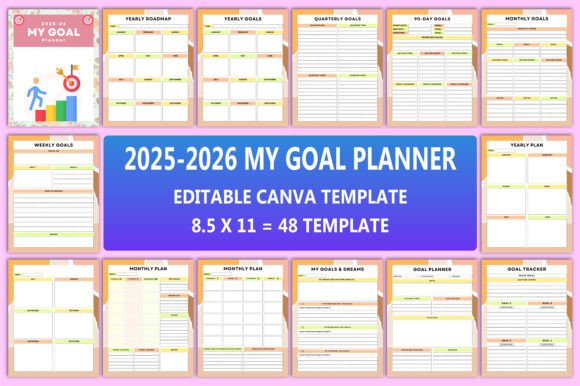
Unlike single-year planners that force abrupt transitions every December, this planner embeds seamless continuity through integrated 2025 and 2026 calendars—each presented in full-page, high-resolution formats. The 2025 calendar isn’t isolated; it flows directly into January 2026, allowing users to map long-term projects, academic semesters, fiscal planning cycles, or personal development milestones without flipping between disjointed documents. Professionals managing quarterly reviews, educators aligning lesson plans with school years, or small business owners forecasting inventory and marketing campaigns all benefit from seeing twelve months of 2025 alongside twelve months of 2026 in one cohesive layout.
The inclusion of both yearly calendars also supports anticipatory planning: spotting overlapping deadlines, identifying seasonal patterns in income or energy levels, and adjusting routines before inertia sets in. For example, someone launching a creative business in Q3 2025 can use the 2026 calendar to pre-schedule brand refreshes, tax preparation windows, or client onboarding rhythms—turning foresight into action.
From Daily Intention to Yearly Vision: Layered Planning That Adapts With You
The Editable 2025-2026 Aesthetic Planner structures time at multiple resolutions—daily, weekly, monthly, and yearly—each serving a distinct cognitive purpose. The Daily Planner page includes space for priorities, time-blocking, and reflection—not just tasks. Paired with Daily Routines and Daily Schedule layouts, it supports habit stacking and circadian alignment, especially valuable for remote workers, caregivers, or neurodivergent individuals seeking predictable scaffolding.
The Weekly Planner offers horizontal time mapping ideal for balancing overlapping commitments—say, teaching three courses while running a freelance design practice. Meanwhile, the Monthly Planner (January–December for both years) features clean grids with ample margin space, encouraging users to annotate themes, emotional trends, or recurring obligations—not just appointments. This layered approach mirrors how memory and motivation actually function: short-term execution anchored by mid-term rhythm and long-term meaning.
Financial Clarity Without Complexity
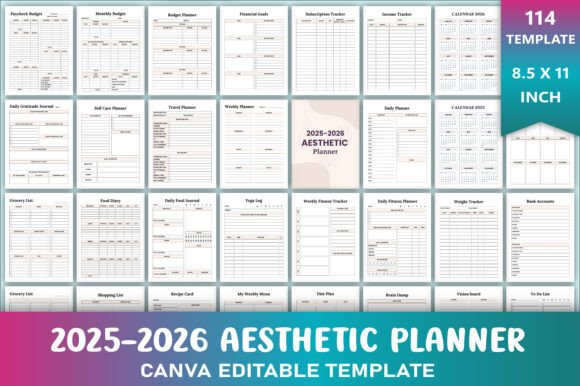
Money management is often sidelined in aesthetic planners—but not here. The Editable 2025-2026 Aesthetic Planner integrates practical financial tracking without sacrificing visual calm. Pages like the Income Tracker, Expense Tracker, and Bill Tracker use minimalist tables with clear headers and consistent spacing—designed for quick logging, not data entry fatigue. More nuanced tools—such as the DEBT Payment Tracker, Credit Card Tracker, and 52 Weeks Savings plan—support behavioral finance principles: breaking large goals into psychologically manageable units.
A teacher saving for graduate school might use the 52 Weeks Savings tracker to deposit increasing amounts each week ($1, $2, $3…), building momentum through compounding consistency. A freelancer could pair the Subscription Tracker with the No Spend Challenge page to audit recurring costs and redirect funds toward skill-building or emergency reserves. These aren’t gimmicks—they’re evidence-informed levers for financial agency.
Wellness as Practice, Not Performance
Self-care pages go beyond affirmations. The Daily Wellness Tracker invites users to log hydration, movement, sleep quality, and screen time—not as metrics to optimize, but as gentle feedback loops. The Self Care Checklist avoids prescriptive language; instead, it lists adaptable prompts like “Did I pause before reacting?” or “Did I protect one boundary today?” Similarly, the Gratitude Journal and I’m Grateful spreads encourage specificity (“I’m grateful for the quiet 20 minutes with my tea this morning”) over generic positivity—aligning with clinical research showing that concrete gratitude improves emotional regulation.
The Self Care Goals and Project Planner sections further integrate wellness into broader life architecture. A researcher preparing for dissertation defense might set a self-care goal like “Schedule two 90-minute focus blocks + one 45-minute walk daily,” then track progress alongside chapter drafts in the Meeting Notes and Travel Planner pages—acknowledging that intellectual stamina depends on embodied stability.
Customization That Serves Function First
The editable Canva link isn’t a decorative add-on—it’s central to the planner’s utility. Users don’t just change colors or fonts for aesthetics; they adapt structure to cognition. A dyslexic educator might increase font size and switch to Open Dyslexic in the Daily Planner; a branding consultant launching a new studio could replace stock icons with custom illustrations in the Goal Action Plan; a non-binary user might revise pronoun fields on the Belongs To page. Because the files are delivered in JPG, PNG, and print-ready PDF formats, edits translate seamlessly to KDP interiors—no reformatting, no pixelation, no layout collapse.
This level of control matters for professionals publishing their own planners, educators tailoring materials for diverse classrooms, or therapists co-creating tools with clients. The ability to modify backgrounds, rearrange sections, or insert personalized imagery transforms passive consumption into active co-design—making organization feel less like compliance and more like authorship.
Real-World Use Cases Across Roles
- Small Business Owners: Combine the Project Planner, Meeting Notes, and Income/Expense Tracker to manage client pipelines, quarterly taxes, and team check-ins—all within one visual language.
- Students & Researchers: Use the Yearly Goals and Goal Action Plan to break thesis timelines into phases, then cross-reference with the Weekly Planner and Daily Schedule to allocate focused study blocks amid teaching or lab responsibilities.
- Creatives & Freelancers: Leverage the Travel Planner, Self Care Planner, and 30 Day Challenge to structure residencies, creative sprints, or portfolio refreshes—while tracking commissions and subscriptions in parallel.
- Parents & Caregivers: Map family birthdays, school events, and medical appointments across the Birthday Calendar and Yearly Events pages, then sync daily routines with the Daily Routines and Gratitude Journal to sustain emotional resilience.
Print-Ready Integrity Meets Digital Flexibility
The Editable 2025-2026 Aesthetic Planner delivers KDP interior files optimized for bleed, trim, and CMYK color fidelity—ensuring professional-grade output whether printed at home, via local print shops, or scaled for Amazon KDP distribution. But its strength lies in the duality: the same PDF used for printing can be annotated digitally using Adobe Acrobat or GoodNotes, while the Canva link enables iterative redesign. A shop owner might print the Monthly Planner for wall display, edit the Expense Tracker monthly in Canva, and annotate the Daily Planner on tablet—blending analog grounding with digital agility.
This hybrid fluency reflects how people actually organize today—not in silos, but across contexts. A meeting scheduled on a shared calendar becomes a note in Meeting Notes; a travel idea jotted in the Travel Planner evolves into a saved Canva mood board; a gratitude entry inspires a social media post drafted in the My Journal section.
Design Ethics Embedded in Every Page
Aesthetic doesn’t mean superficial. The Editable 2025-2026 Aesthetic Planner applies design ethics intentionally: generous white space reduces cognitive load; consistent typography hierarchy supports scanning; subtle grid lines guide writing without constraining thought; and inclusive iconography avoids gendered or ableist assumptions. Even the Bank Accounts tracker uses neutral labels rather than defaulting to “primary/secondary”—recognizing diverse financial arrangements.
When customization options include changing layouts—not just colors—the tool respects user autonomy. When the No Spend Challenge includes reflection prompts about spending triggers, not just checkboxes, it acknowledges behavior change as relational and contextual. This is organization designed with empathy, not efficiency alone.
Final Thought: Organization as an Evolving Dialogue
The Editable 2025-2026 Aesthetic Planner succeeds because it refuses to treat planning as a fixed destination. Its dual-year scope acknowledges that growth unfolds across cycles—not just within them. Its editable framework affirms that your needs, roles, and priorities will shift—and your tools should shift with you. Whether you’re launching a startup, navigating caregiving transitions, returning to education, or simply reclaiming attention in a distracted world, this planner provides the structure to begin—and the flexibility to evolve.