I Spy Valentine’s Day for Kids
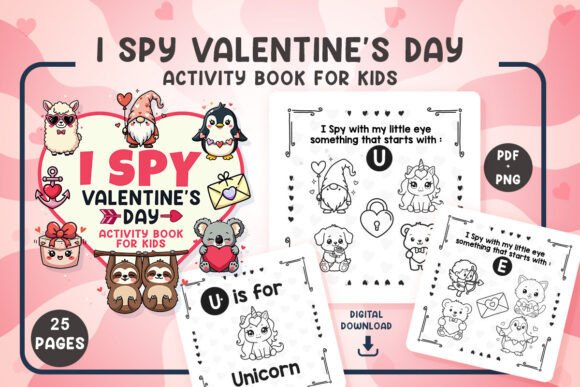
At its heart, I Spy Valentine’s Day for Kids isn’t just another activity book—it’s a thoughtfully crafted visual experience designed to hold attention, spark curiosity, and support early learning through play. The 26-page PDF features clean, high-resolution PNG illustrations sized at 8.5 x 8.5 inches—ideal for crisp home printing or digital use in classrooms and therapy settings. Every page bursts with cheerful, age-appropriate Valentine’s motifs: candy hearts, smiling cupids, wrapped gifts, lace doilies, love notes, and fuzzy teddy bears—all rendered with consistent line weight, balanced negative space, and warm, accessible color palettes.
The aesthetic leans into friendly modern illustration: rounded shapes, soft shadows, and gentle contrast—not overly stylized, but never generic. It avoids visual clutter while maintaining enough detail to sustain focus during scanning and counting tasks. That balance is intentional. Too much complexity overwhelms young eyes; too little fails to engage. This version lands squarely in the sweet spot: expressive enough to feel joyful, structured enough to support cognitive scaffolding.
Where This Design Asset Fits Naturally
I Spy Valentine’s Day for Kids works especially well in contexts where clarity, warmth, and developmental intention intersect. Think classroom handouts, speech-language therapy worksheets, occupational therapy visual discrimination drills, or homeschool morning baskets. Its square format and centered layout make it easy to adapt for social media carousels (Instagram, Pinterest), digital newsletters, or printable party kits. Small business owners creating themed subscription boxes or craft kits often pull individual pages as branded inserts—especially the “Find 5 Hearts” or “Spot the Matching Socks” spreads.
Designers building seasonal brand identities for children’s products find value here not just as a standalone tool, but as a reference point for tone and texture. The consistency across pages—same stroke weight, same spacing rhythm, same emotional register—offers a quiet lesson in visual hierarchy and repetition. You don’t need to reinvent the wheel when launching a new line of Valentine-themed stickers or greeting cards; this asset already models how to balance charm with legibility.
Why Visual Consistency Matters More Than You Think
When you’re designing for kids aged 3–8, every stylistic choice communicates something—even unintentionally. A jagged, high-contrast font might read as “exciting” to an adult, but to a child still developing visual processing skills, it can feel chaotic or even stressful. I Spy Valentine’s Day for Kids sidesteps that by using generous spacing between objects, predictable alignment, and limited color variation per spread. That consistency doesn’t just aid comprehension—it builds trust. Kids return to activities they can navigate confidently.
That same principle applies off the page. If you’re a blogger curating seasonal learning resources, embedding one of these pages into a post signals reliability—not because it’s flashy, but because it feels *considered*. Readers subconsciously associate that care with your broader content. For publishers compiling themed workbooks, pairing this asset with complementary fonts (like a gentle sans serif for instructions or a subtle handwritten style for titles) reinforces cohesion without competing for attention.
Practical Tips for Integrating It Well
- Test before scaling: Print a single page at actual size first. Check that small details—like the stripe on a candy heart or the bow on a gift box—remain clear on your printer. Some home inkjets soften fine lines; adjusting print quality settings or choosing “high resolution” mode helps.
- Respect the grid: The layout uses an implicit 3×3 visual grid. When adapting pages for digital slides or apps, maintain those spatial relationships. Don’t stretch or crop elements asymmetrically—doing so disrupts the scanning pattern kids rely on.
- Pair intentionally: If adding text overlays (e.g., “How many roses can you find?”), choose a sans serif with open counters and tall x-heights—think Quicksand, Nunito, or Comic Neue. Avoid decorative script fonts for functional labels; they slow decoding.
- Licensing clarity: This is a commercial-use asset—no attribution required—but always verify license terms before bundling into a paid product (e.g., a $12 “Valentine Learning Bundle” on Etsy). Most reputable sellers include a clear PDF license; if yours doesn’t, reach out before resale.
Not Just for February—A Year-Round Resource
Don’t limit I Spy Valentine’s Day for Kids to February. Its core strengths—visual discrimination, counting practice, color recognition, and sustained attention—are foundational skills that transfer across seasons and subjects. Rotate pages into summer review packets, use them as calm-down tools during transitions, or repurpose object lists for vocabulary building (“What sound does ‘envelope’ start with?”).
Crafters and small business owners often overlook how reusable these assets are. A single “Find the Matching Keys” page becomes a tactile sorting game when printed, laminated, and paired with mini plastic keys. A “Count the Cupids” spread transforms into a simple graphing exercise with colored stickers. The design doesn’t shout—it invites extension. That flexibility is why educators and content creators keep coming back to well-executed I Spy formats: they’re low-lift, high-impact, and quietly versatile.
If you’re evaluating whether this fits your workflow, ask yourself two things: Does it solve a real problem I see daily? And does it align with the tone I want my audience to feel—capable, supported, and gently delighted? With I Spy Valentine’s Day for Kids, the answer tends to be yes—both times.